
2024 – 2026
PairSonic
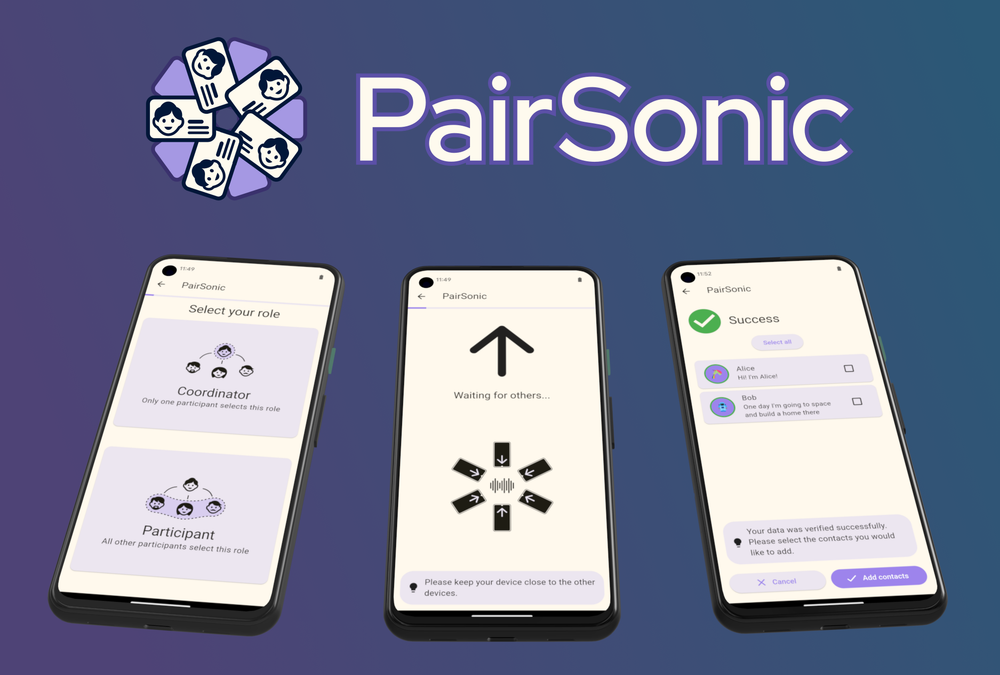
Setting up secure chats in messenger apps such as Signal is often a pain, as users have to manually verify the public keys of their contacts to ensure end-to-end encryption. Especially in larger groups, this process is cumbersome and can take a lot of time.
We have developed PairSonic, which is an open-source smartphone app that enables two or more users meeting in person to spontaneously exchange or verify their contact information. PairSonic simplifies the pairing process by automating the tedious verification tasks of previous methods through an acoustic out-of-band channel using smartphones’ built-in hardware. It does not rely on external key management infrastructure, prior associations, or shared secrets.
But is PairSonic really more user-friendly than current approaches? To answer this question, we conducted a user study where 45 participants compared PairSonic to the current state of the art. The questionnaires and subsequent interviews showed that participants significantly preferred our system PairSonic.
🏆 This study won a best paper award at CSCW’24 (top 1% of papers).
However, PairSonic’s acoustic channel also has practical limits: it is deployable on today’s smartphones, but not always as reliable as we would like. In our follow-up work Pair-Fi, we asked whether we can get the robustness of an RF-based out-of-band channel without giving up commodity smartphone hardware. By modifying the firmware of widely used Broadcom Wi-Fi chips, Pair-Fi enables a faster and more reliable RF-based channel with physical-layer security.
🏆 This paper won a best paper award at WiSec’26.